Wringer washing machine – a New Brunswick invention
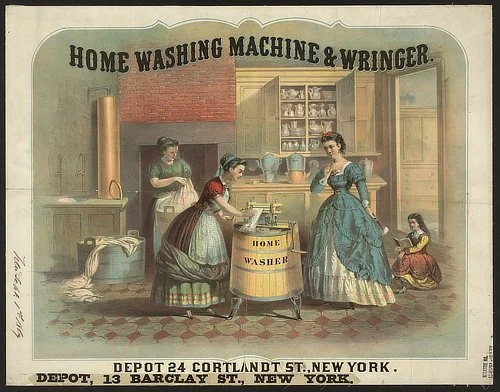
A vintage ad for the ‘Home Washing Machine & Wringer’ from 1869. It depicts a 19th-century scene showing women using early laundry technology, especially a wooden tub machine with an attached hand-cranked mangle or wringer. Public domain courtesy of the Library of Congress.
A New Brunswick invention that helped change wash day forever
In 1843, Saint John, New Brunswick, inventor John E. Turnbull patented a ‘clothes washer with wringer rolls,’ one of the earliest machines to combine washing and wringing into a single household appliance. Earlier washing tubs and mangles already existed, but Turnbull’s design integrated the two into one practical machine for domestic use.
At a time when laundry was still done largely by hand, wash day was one of the most exhausting household chores. Clothes had to be soaked, scrubbed, rinsed and then wrung out by hand before being hung to dry. For large families, the process could consume a whole day.
Precise details of Turnbull’s original machine are surprisingly difficult to pin down today. Later accounts describe everything from hand-cranked baskets to spring-loaded wringer rolls. What is clear is that the machine used rollers to squeeze water from clothing, greatly reducing the labour of wringing garments by hand.
The wringer functioned much like a modern washing machine’s spin cycle. Wet clothing was fed between spring-loaded rollers turned by a hand crank, forcing excess water back into the washing tub. The system made laundry work faster, less messy and physically easier.
Large items such as blankets and bed sheets could still be cumbersome to wash. While the wringer could be adjusted to accommodate different thicknesses, large items like bed sheets would often get twisted in the washing tub and needed to be untwisted before it could be put through the wringer but the wringer still did a good job of removing the excess water, hence speeding up the drying time.
It wasn’t until the early 20th century that an electric washing machine was developed and by the 1940s more than half the homes in Canada had one and wringer-washers were still being used well into 1960s. Of all the home time-saving devices, perhaps it was the washing machine that truly helped housewives the most, freeing up valuable time.
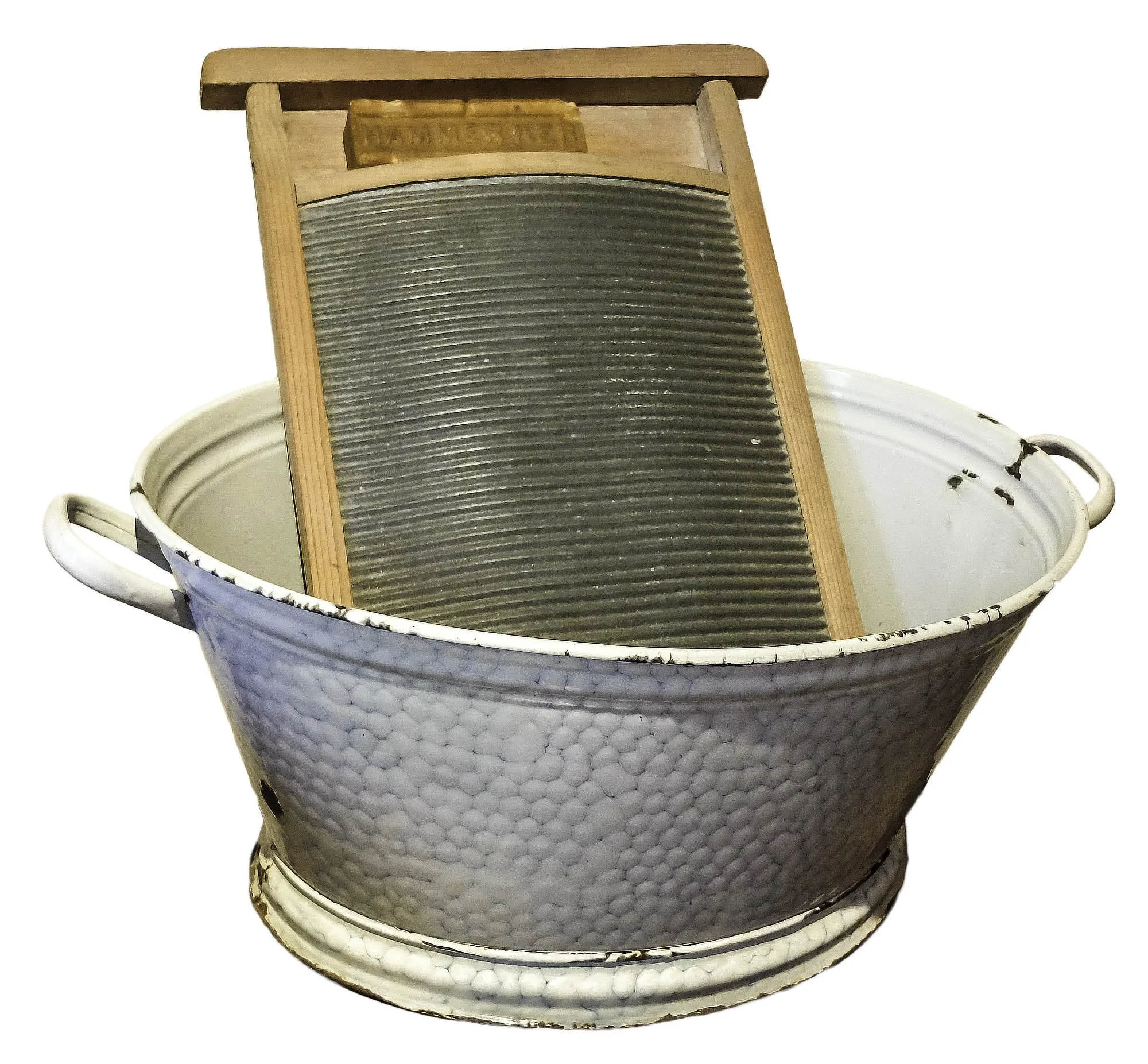
In 1833, the washboard was invented by Stephen Rust of New York. It featured a wooden frame holding a fluted piece of tin, sheet iron, copper or zinc. While rough surfaces like rocks have always been used for scrubbing, the washboard was portable and made the process of washing clothes faster and easier.
Laundry Before the Wringer Washer
Doing laundry has traditionally been performed largely by women, both in their own homes and as a profession. Large households and estates often hired laundresses to handle the labour-intensive task.
In ancient times, laundry was often done in rivers, lakes or streams, where the natural flow of water helped wash away impurities. Later, public washhouses were built near rivers and wells in many European cities. These became important social gathering places where women could share stories and news while washing clothes.
Wash day was time-consuming and physically demanding. Women hauled heavy buckets of water, soaked clothing and scrubbed fabrics on washboards. Boiling water was often used to sanitize linens and undergarments before clothes were hung on lines or spread across grassy fields to dry in the sun.
In many households, Monday was traditionally reserved for laundry so clothes would have time to dry, be ironed and prepared for Sunday best. Because wash day was so labour-intensive, some historians believe this routine helped give rise to the expression ‘blue Monday,’ a phrase still associated with gloomy Mondays today.