Nancy Mosley – New Brunswick’s First Murderess
Early Saint John, NB. Illustration by C. W. Jefferys from The Picture Gallery of Canadian History (Ryerson Press, 1945). The large house in the lower right is identified as the residence of Benedict Arnold, who settled in Saint John for several years after the American Revolution.
A deadly quarrel, a sympathetic jury, and a centuries-old legal loophole that saved a Black Loyalist woman from the gallows
Standing before the court in February 1785, Nancy Mosley faced the gallows. Convicted of killing her husband, the Black Loyalist woman from Parrtown had just been sentenced to death.
Then she made an extraordinary request.
Nancy asked the court for the ‘benefit of clergy.’
The phrase might have sounded like a plea for a minister’s prayers before execution, but that was not what she meant. Nancy was invoking an ancient provision of English law, one that, if granted, could spare her life.
Her story had begun four months earlier.
On October 4, 1784, Nancy Mosley was arrested for the murder of her husband, John Mosley, in their home in Parrtown (now Saint John), New Brunswick.
The case was filled with firsts. It was the first recorded murder in the newly formed colony. The first autopsy was performed by the coroner, Dr. Samuel Moore. And New Brunswick’s first Grand Jury, composed of nineteen white Loyalist men, was convened to consider the case.
Nancy’s case unfolded at a remarkable moment in the region’s history, when Loyalist refugees were building a new colony, Black Loyalists were struggling to establish new lives, and New Brunswick’s courts were hearing their first criminal cases.
According to a confession Nancy made at the time of her arrest, an argument began when she refused to bake more bread, telling her husband he would have to eat what she had already prepared. Enraged, John Mosley reportedly came at her with an axe. Trying to defend herself, Nancy struck back with a fork she had in her hand, stabbing him in the head.
Though wounded, John Mosley initially seemed to recover and took to his bed. But several days later his condition worsened and he died from his injuries.
By October 6 there was enough evidence to charge Nancy with the murder of her husband. She was indicted by the newly formed Grand Jury. Among the nineteen men who served on this first jury was John Ryan, printer and publisher of The Royal St. John’s Gazette and Nova-Scotia Intelligencer. There is no record that Nancy had legal representation.
Her trial did not take place until four months later. On February 3, 1785, Nancy Mosley stood before the court charged with murder. A petit jury of twelve men quickly returned a verdict of manslaughter, though they added a recommendation of mercy.
The judge, however, sentenced her to death.
Nancy, it seems, was literate and may have known something about English common law. Standing before the judge, this Black woman asked that she be granted the ‘benefit of clergy.’
The privilege dated back to medieval England. Originally it applied only to members of the clergy, who were often the only people able to read and write. Over time the protection was extended to others who could prove their literacy by reading a passage from the Bible. The verse commonly used was from Psalm 51:
Have mercy upon me, O God, according to thy loving kindness; according unto the multitude of thy tender mercies blot out my transgressions.
Nancy successfully claimed the privilege.
Instead of execution, she was branded with the letter ‘M’ on the brawn of her left thumb, marking her conviction for manslaughter and recording that she had received the benefit of clergy. The mark ensured that if she were ever convicted of another serious offence, she could not claim the privilege a second time.
After that moment, Nancy Mosley disappears from the historical record, leaving behind only the mark on her thumb and the story of New Brunswick’s first murder trial.
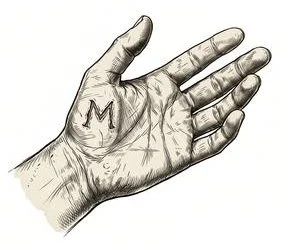
AI generated image of a hand branded with the letter ‘M’.
A Mark That Could Not Be Erased
Those who successfully claimed the benefit of clergy were often branded on the thumb with a letter marking their offence.
In cases of manslaughter the mark was usually the letter ‘M.’
The branding served an important legal purpose. In an age before photographs or criminal records, the mark allowed court officials to see immediately whether a person had already received the privilege. If the offender later appeared in court again, the branded thumb showed that the benefit had already been used and could not be claimed a second time.
The thumb was chosen deliberately, it was easy for court officials to inspect.
For Nancy Mosley, the brand on her thumb meant that she had escaped execution. But it also ensured that the law would never grant her the same mercy again.
The ‘Neck Verse’
The passage used to test literacy when someone claimed the ‘benefit of clergy’ became known as the ‘neck verse.’
It earned this nickname because being able to read the verse, usually from Psalm 51, could literally save a person’s neck from the gallows.
Some defendants are believed to have memorized the verse even if they could not truly read, repeating it aloud when handed the Bible in court.
Timeline of The Nancy Mosley Case
October 4, 1784
Nancy Mosley is arrested in Parrtown for the murder of her husband.
October 6, 1784
A newly formed Grand Jury indicts her for murder.
October 1784
Dr. Samuel Moore performs what is believed to be the first recorded autopsy in New Brunswick.
February 3, 1785
Nancy Mosley stands trial. A petit jury finds her guilty of manslaughter and recommends mercy.
February 1785
Nancy claims the benefit of clergy. She is branded with the letter ‘M’ and released.
-
References and Sources
Davidson, S. (March 27, 2011). United Empire Loyalists Association of Canada. Loyalist Trails 2011-12. CSI: Loyalist Edition.Lawrence, J. W. (1874, November 25). The first courts and early judges of New Brunswick. Paper read before the New Brunswick Historical Society.
Image:
Jefferys, C. W. (1945). Early Saint John, NB [Illustration]. In The picture gallery of Canadian history (Vol. 2: 1763–1830, p. 20). Ryerson Press. Retrieved from Internet Archive: https://archive.org
You Might Also Like:

The Royal St. John’s Gazette and Nova-Scotia Intelligencer
On of the members of the Grand Jury that indicted Nancy Mosley was John Ryan, publisher of New Bruswick’s first newspaper. Read his story here.