Edith Jessie Archibald
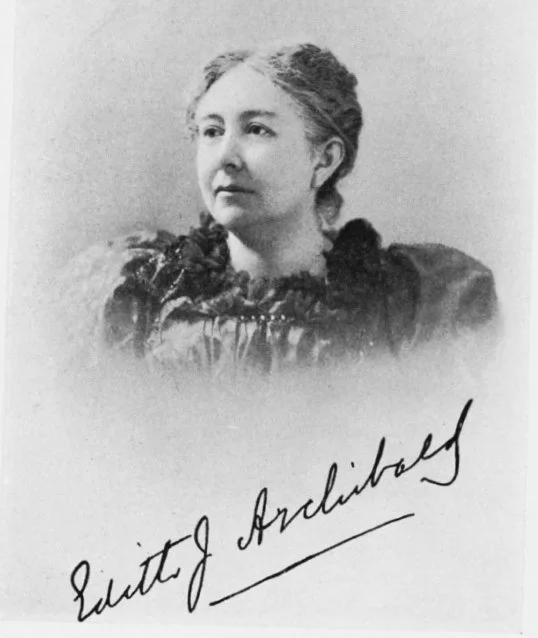
‘Lady of Grace’
In recognition of her humanitarian and public service work, Edith Jessie Archibald was named a ‘Lady of Grace’ of the Order of St. John, an honour associated with charitable and medical service throughout the British Empire. King George V reportedly referred to her by the title.
A determined reformer who helped bring the fight for women’s suffrage to Atlantic Canada.
Edith Jessie Archibald (1854 – 1936) was a Canadian suffragist, writer and social reformer who became one of the leading voices for women’s rights in Atlantic Canada. She served as president of the Maritime Woman’s Christian Temperance Union (WCTU), the National Council of Women of Canada and the Local Council of Women of Halifax. King George V later honoured her as a ‘Lady of Grace,’ and in 1997 she was designated a Person of National Historic Significance by the Canadian government.
Born in St. John’s into a prominent family with a long history of public service, Edith was educated in both London and New York City. Her education and family connections helped prepare her for the influential public role she would later take on in Canada’s growing reform movements.
In 1874, at the age of twenty, she married her second cousin, Charles A. Archibald, a mining engineer who owned Gowrie Mine in Cow Bay (now Port Morien) in Cape Breton.
Although Edith and Charles lived comfortably compared with most mining families, life in Cow Bay exposed her to the hardships faced by coal miners and their wives. Dangerous working conditions, poverty and alcohol abuse were common concerns in many mining communities of the era and likely helped shape her growing interest in temperance and social reform.
It was in Cow Bay that Edith first became deeply involved in social reform work through the WCTU. Far from being a quiet supporter, she took direct action, famously leading raids on three illegal saloons. In one case, Charles purchased one of the hotels involved and transformed it into a temperance hotel. Edith also organized ‘parlour meetings’ where women gathered to discuss temperance, social reform and the growing movement for women’s rights.
Charles sold the mine in 1894 and became president of the Bank of Nova Scotia in Halifax where Edith’s sphere of influence expanded even further.
Although temperance was her entry point into public activism, women’s suffrage became one of her greatest causes. She strongly believed women deserved both a political voice and greater influence in public life. Through speeches, organizing and national advocacy, she helped build support for women’s enfranchisement in Canada, achieved federally in 1918.
During her long public career, Edith held leadership positions in numerous organizations, including:
• President of the Maritime Woman’s Christian Temperance Union (1892 – 1896)
• President of the Halifax Local Council of Women (1896 – 1906)
• President of the Halifax Victorian Order of Nurses (1897 – 1901)
• Vice-President of the Nova Scotia Red Cross in 1914, where she chaired the department responsible for Canadian prisoners of war overseas.
Edith Jessie Archibald spent much of her life working behind the scenes to improve public health, expand opportunities for women and strengthen social services in Canada. While many of the battles she fought are now largely forgotten, her work helped lay the foundation for future generations of Canadian women.
In 1998 Edith was designated a National Historic Person by the government of Canada and a plaque was erected in her honour. The plaque is located in front of the Women’s Council House in Halifax, Nova Scotia.
The WCTU and Women’s Reform
Founded in the United States in 1874, the Woman’s Christian Temperance Union (WCTU) quickly spread across Canada. Although best known for campaigning against alcohol, the organization also became one of the first major public reform movements led by women.
At a time when women could not vote or hold political office, the WCTU gave women opportunities to organize meetings, speak publicly, lobby governments and advocate for social change. Many members, including Edith Jessie Archibald, became active in causes such as women’s suffrage, public health, prison reform and child welfare.
For many Canadian women, the temperance movement became an important stepping stone into public and political life.
-
Forbes, E. (2025). Edith Jessie Archibald. In The Canadian Encyclopedia. Retrieved from https://thecanadianencyclopedia.ca/en/article/edith-jessie-archibald
Wikipedia contributors. (2026, April 28). Edith Archibald. In Wikipedia, The Free Encyclopedia. Retrieved 11:05, May 20, 2026, from https://en.wikipedia.org/w/index.php?title=Edith_Archibald&oldid=1351510283
Morgan, Henry James. (1903). Types of Canadian Women and of Women Who are or Have Been Connected with Canada. William Briggs, Toronto. Internet Archive edition.
Historic plaque
https://commons.wikimedia.org/wiki/File:EdithArchibaldPlaqueNovaScotia.jpg

You Might Also Like:

Canada’s first woman PhD and champion of education in the Maritimes.