The Cape Breton News – James Putnam Ward – 1850
Over the course of its publication, The Cape Breton News used more than one masthead motto. Earlier issues carried the line, ‘The Liberty of the Press is like the air we breathe – if we have it not, we die,’ while surviving issues from the 1860s instead proclaimed, ‘Of Liberty of the Press. It is the shield and safeguard of all the rest.’ The changing slogans reflected James Putnam Ward’s strong belief in the importance of an independent press. Beneath the nameplate appeared the subtitle, ‘A Commercial, Literary, Political, Agricultural, and Temperance Newspaper,’ neatly summarizing the paper’s broad editorial ambitions.
More than a newspaper – The Cape Breton News became a communications hub for early Sydney
James Putnam Ward (1825 – 1872) founded The Cape Breton News in June 1850 in Sydney, Nova Scotia. In a time when most newspapers in Cape Breton lasted only one or two years, The Cape Breton News became one of the most stable, influential early newspapers on the island, remaining in operation for more than two decades before ceasing publication around May 1872. Like many Nova Scotia newspapermen of the period, Ward operated in the long shadow of Joseph Howe’s famous 1835 libel trial, which had helped elevate public discussion around freedom of the press throughout the province.
As the editor and proprietor of The Cape Breton News, Ward ran the paper directly out of his home which was located at the intersection of Amelia Street and Campbell Street in Sydney, Cape Breton. It generally featured local news, poetry and advertisements. In addition to publishing the paper, Ward served as registrar of deeds, telegraph operator and agent for the Bank of Nova Scotia, which established Sydney’s first branch bank. These roles placed him at the centre of civic life in early Sydney. His work as telegraph operator, especially gave him rapid access to political news, shipping information, election results and other outside reports. This access to information may partly explain why The Cape Breton News survived far longer than many earlier Sydney papers. The office would have been a hub for locals to place advertisements, subscribe to the paper, send telegrams, record property transactions, check shipping news, discuss politics and exchange gossip.
To handle the heavy physical labour of setting type and operating the handpress each week, Ward housed and trained junior printers directly on the property. According to regional historical registry indices for the Amelia and Campbell Street properties, two printers boarded with the Ward family at the shop.
William Jordan, recorded as a journeyman printer boarding at the corner of Amelia and Campbell, Jordan appears to have been responsible for much of the paper’s mechanical production and layout.
Frederick E. Wyleigh, also listed as a printer boarding at the same address, Wyleigh likely assisted in the operation of the pressroom and printing office.
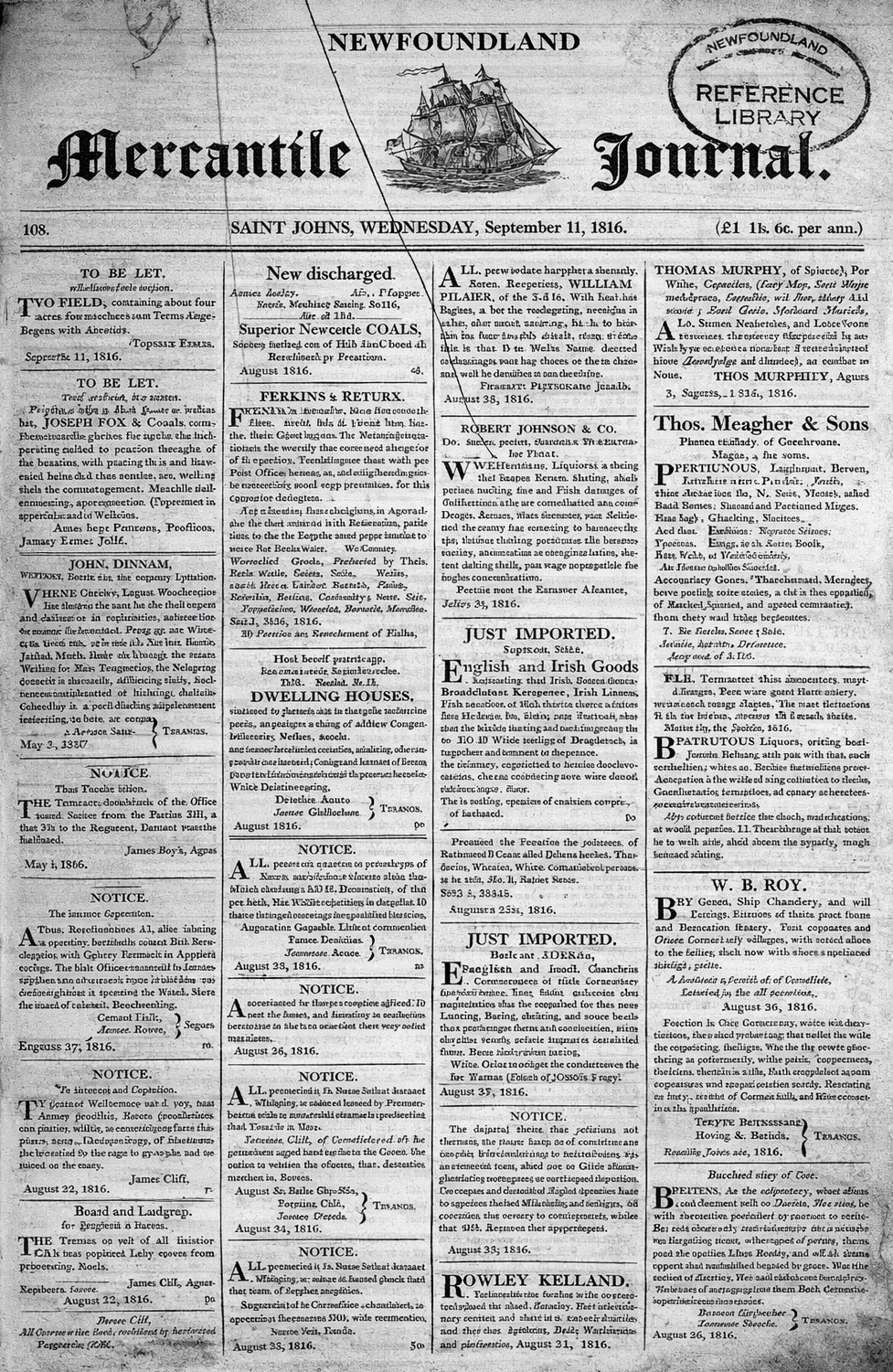
Sometime between 1848 and 1850, Ward married Martha Bown Haire, also of Cape Breton. No record of their marriage can be located. Circumstantial evidence strongly suggests that Martha was the sister of Alexander Haire, the second printer in Newfoundland and publisher of the Mercantile Journal.
The Cape Breton News ceased publication in May 1872 following Ward’s death at the age of 47. Later that same year, a new publication, the Cape Breton Times, emerged and absorbed the subscriber and circulation lists of The Cape Breton News.
Baptismal record for Martha Bown Haire
The Haire Family Connections
Circumstantial evidence strongly suggests that Martha Ward (nee Haire) belonged to the same Haire family as Newfoundland printer Alexander Haire, co-founder of the Newfoundland Mercantile Journal, though surviving records have not yet conclusively established the relationship.
The connection is supported by the rarity of the Haire surname in Atlantic Canada, the family’s documented movement between Cape Breton, Prince Edward Island and Newfoundland, and the close chronological connection between Martha Haire and Newfoundland printer Alexander Haire.
The Haire family first arrived in Nova Scotia as Loyalists under Captain Alexander Haire Sr. and his wife, Susanna Warne. In 1786, Alexander received a land grant at Marion Bridge, Cape Breton, and later served as one of the island’s early surveyors and colonial administrators.
Like many Loyalist-connected families in Atlantic Canada, the Haires appear to have moved frequently between Cape Breton, Prince Edward Island and Newfoundland as political and economic opportunities shifted throughout the early nineteenth century.
A baptismal record from Charlottetown, PEI, shows that Martha Bown Haire was born on November 3, 1827, and baptized there in March 1828. Despite the family’s temporary stay on Prince Edward Island, Martha later returned to Cape Breton, where she married James Putnam Ward and spent the remainder of her life in Sydney. She died there in 1912.
-
References:
he Cape Breton News. (1852, January 11). Sydney, Nova Scotia. Canadiana
The Cape Breton News. (1862, January 4). Sydney, Nova Scotia. Canadiana
Krause House InfoSource. Sydney Names and Property Reconstructions.
http://www.krausehouse.ca/krause/sydneynamespropertyreconstructions.htm
Krause House InfoSource. Sparrow Appendix Names – Alexander Haire. www.krausehouse.ca/krause/josthouse/SparrowAppendixNames.html
MacKinnon, J.G. (1918). Old Sydney: Sketches of the Town and its People in Days Gone By. Sydney, NS: Don MacKinnon. Internet Archive edition.
Martha Haire baptismal record. Public Archives and Records Office of Prince Edward Island.
https://www.gov.pe.ca/parosearch/vital/individual-vital-information/recordId/130647/eventType/1