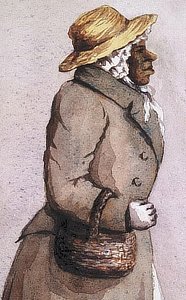
Marie Marguerite Rose
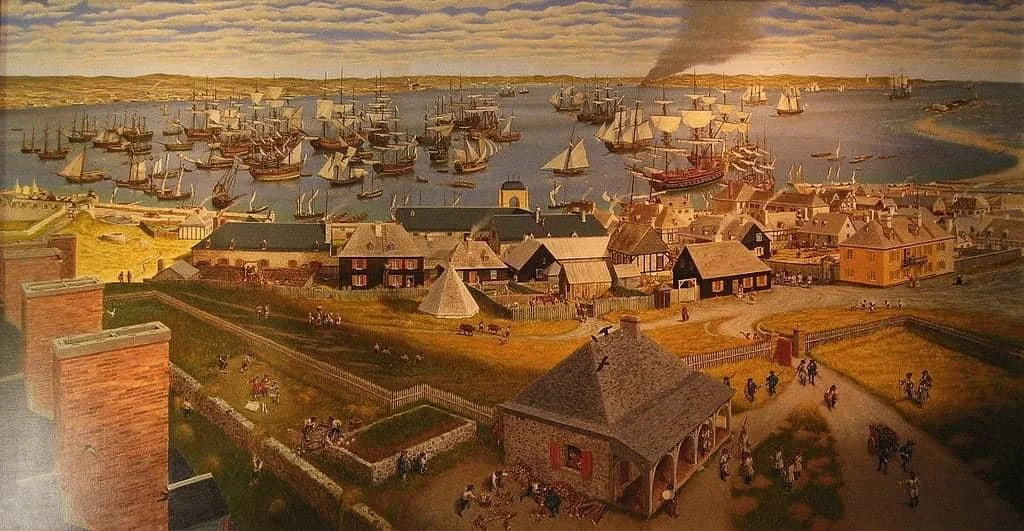
The Fortress of Louisbourg in the 1740s during the lifetime of Marie-Marguerite Rose. Painting based on Lewis Parker’s View from a Clock Tower, Louisbourg, 1744. Source: Dictionary of Canadian Biography.
Taken from West Africa and enslaved at Louisbourg, she built a new life in one of colonial Canada’s busiest towns.
At the age of 19, Marie Marguerite Rose (1717 – 1757) was taken from her home in Guinea, West Africa, transported across the Atlantic and enslaved by a French soldier at Louisbourg, Cape Breton Island. Few could have imagined that the young enslaved woman would later rise to become one of the most successful businesswomen in 18th-century Louisbourg.
In 1736, Marie was enslaved by Jean-Chrysostome Loppinot, an officer in the French garrison at Louisbourg. Two years later, she gave birth to a son, Jean-François, who, under French colonial law, was also born into slavery. His baptismal record lists the father as ‘unknown,’ but historians believe the child was likely fathered by Loppinot himself, reflecting the vulnerability of enslaved women in colonial society.
The Loppinot household grew from two people to a family of eight, and Marie spent years cooking, cleaning and caring for the children. In 1745, British forces captured Louisbourg and the family fled to France. Five years later, after Louisbourg was returned to France, they returned to Cape Breton.
Marie remained with the household for another four years, enduring both hardship and personal tragedy. During this time, her son Jean-François died shortly after his 13th birthday. Sometime before 1755, after nearly two decades in slavery, Marie obtained her freedom. Historians do not know exactly why she was emancipated, but by this point she had devoted much of her adult life to the Loppinot family.
On November 27, 1755, Marie married Jean-Baptiste Laurent in Louisbourg. Laurent was described in the marriage record as an ‘Indian,’ indicating he was likely Mi’kmaq. Five months later, the couple acquired a two-storey apartment in a comfortable half-timbered house across the street from the Loppinot residence. Their home included rooms with fireplaces and windows overlooking the busy colonial town, along with access to a courtyard containing a well and garden.
Together, Marie and Laurent opened a tavern. An inventory taken after Marie’s death in 1757 revealed a surprisingly comfortable life. She owned colourful clothing, silk stockings, jewellery, household furnishings and even a copy of Le Cuisinier roïal et bourgeois (‘The Royal and Bourgeois Cook’), a popular French cookbook of the era.
Although Marie was illiterate, she quickly earned a reputation for her business skills. Records suggest she sometimes conducted transactions independently of her husband – something highly unusual for a woman in 18th-century Louisbourg and contrary to the legal norms of New France.
Marie-Marguerite Rose died in 1757 at the age of 40 and was buried in Louisbourg. By the time of her death, she had risen from slavery to become a respected businesswoman in one of the most important towns in New France. Despite the remarkable records that survive about her life, her story remained largely overlooked for generations before being formally commemorated by Parks Canada and the Historic Sites and Monuments Board of Canada in the early 21st century.
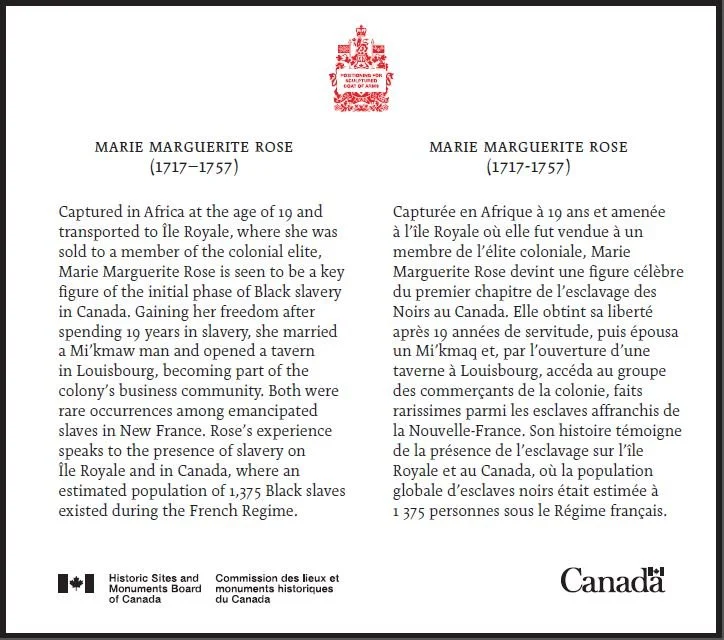
Marie’s Plaque
Marie-Marguerite Rose was officially designated a National Historic Person 2008. A commemorative plaque was erected by Historic Sites and Monuments Board in 2010 at the Fortress of Louisbourg. Source: Dictionary of Canadian Biography.
Inside Marie’s Home
When Marie-Marguerite Rose died in 1757, officials recorded the contents of her home and tavern. The inventory provides a remarkable glimpse into the life she had built after nearly two decades in slavery.
Her home itself was modest but comfortable. The downstairs rooms served as both living quarters and tavern space, furnished with wooden tables, benches and straw-seated chairs where customers gathered to eat, drink and socialize. The kitchen contained pewter spoons, iron forks, cooking pots and goblets, while upstairs stood a feather bed with wool blankets and well-used sheets.
The inventory also revealed the workings of a busy household and tavern. Marie had large quantities of coffee, sugar, tobacco, wine, brandy and even hundreds of walnuts stored in the house. Despite being illiterate, she owned a horn inkwell and a copy of Le Cuisinier roïal et bourgeois (‘The Royal and Bourgeois Cook’), a popular French cookbook of the period.
Other items showed that Marie’s skills extended far beyond cooking and tavern keeping. She sewed, knitted, dyed cloth, ironed clothing and made soap. She and her husband also maintained a productive garden whose vegetables became one of the most valuable assets listed in the estate inventory.
Taken together, the objects left behind paint a vivid portrait of a woman who had risen from enslavement to build a successful and respected life in colonial Louisbourg.
-
References:
Donovan, Ken. (2003) “Marguerite (Marguerite Rose (Roze) (Laurent) (Marie Rose, Mme Rose),” in Dictionary of Canadian Biography, vol. 3, University of Toronto/Université Laval, 2003–, accessed May 21, 2026, https://www.biographi.ca/en/bio/marguerite_3E.html.
You Might Also Like