The Blockhouses of Nova Scotia
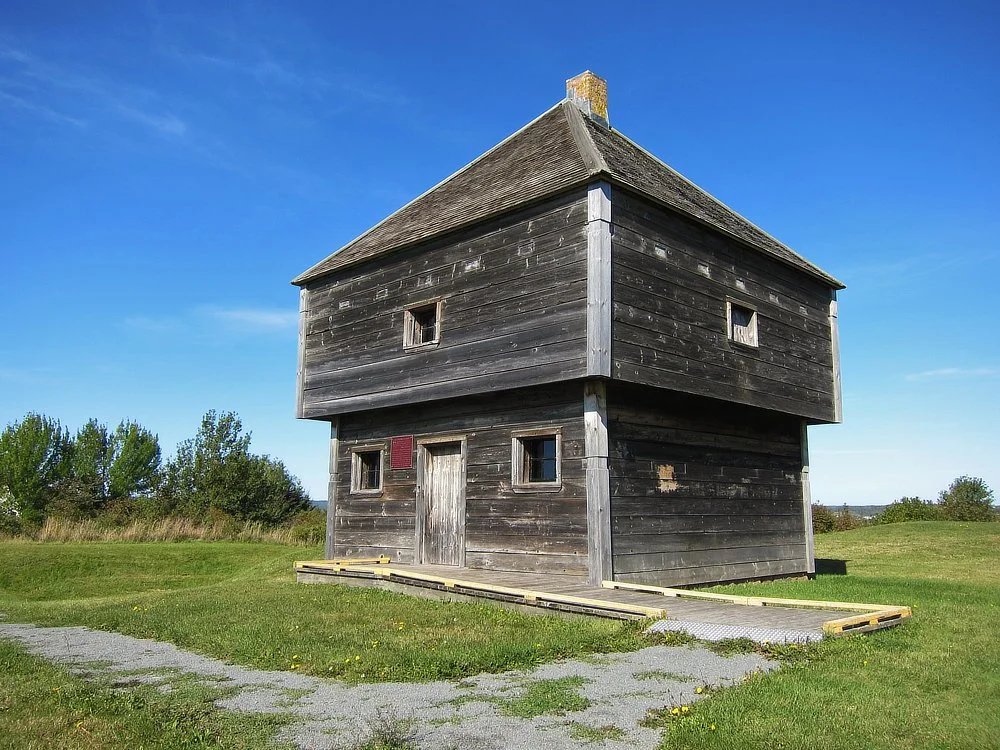
Restored blockhouse at Fort Edward National Park in Windsor, Nova Scotia built in 1750.
A roadside sign near Mahone Bay led to the story of the wooden blockhouses that once guarded settlers across colonial Atlantic Canada.
The small roadside sign between Bridgewater and Mahone Bay was easy to miss, but it hinted at a time when Nova Scotia’s landscape was dotted with wooden blockhouses built to protect settlers in a dangerous frontier colony. All the sign said was ‘Blockhouse 1754’. What did that refer to? 1754 was obviously a date but what was blockhouse? Further research uncovered the story.
Blockhouses were typically two-storey wooden defensive structures built by the British throughout Atlantic Canada from the 1740s into the early 1800s. Positioned near settlements, roads and harbours, they served as lookout posts and places of refuge during periods of conflict involving the British, Mi’kmaq, Acadians and French forces. Hundreds were eventually built across British North America, though only a handful survive today.
The first blockhouses in Nova Scotia were generally built around the same time. Most blockhouses were intended only as temporary works, prefabricated in Halifax and shipped around the province as needed. Three blockhouses were built around 1751 to protect the Halifax peninsula. Following attacks in 1749 and 1750 a blockhouse was built at Dartmouth Cove (across the harbour from Halifax). Around 1752 or 1753, another one was built in the County of Lunenburg. Fort Edward at Windsor was built in 1750 and is considered one of the oldest surviving blockhouses in Nova Scotia.
Typical design features included a strong timber foundation, second-story overhangs (machicolations). Machicolations are permanent, projecting galleries built at the top of the blockhouses that had openings in the floor that allowed defenders to fire directly downward onto the enemies below while they remained protected. They eliminated blind spots at the bottom of walls. Blockhouses usually had two rooms connected by a stairway and were about 12 feet square and 25 feet in height. The were manned by an officer and often surrounded by a palisade of double pickets made of sharpened wooden stakes or logs that were the first-line of defence.
In the photo above, the small rectangular openings near the upper level and on the side are loopholes designed for muskets. Their narrow shape made it difficult for attackers to shoot inside while allowing defenders to fire outward from relative safety.
By the early 1760s, most blockhouses had been abandoned. Their lands passed into private hands, and over time the wooden structures disappeared into the landscape, leaving behind little more than place names and scattered ruins.
The village of Blockhouse
The small roadside sign refers to the village of Blockhouse in Lunenburg County. Many travellers likely pass through without realizing the name comes from a military structure built during Nova Scotia’s turbulent frontier years.
The community was named after a blockhouse constructed by Captain Ephraim Cook following raids in the early 1750s. The area later experienced additional attacks during the 1758 Lunenburg campaign, when several settlers were killed. Although the original blockhouse disappeared long ago, the community near Mahone Bay still preserves the name.
-
References:
Fort Edward Block House at Windsor, Nova Scotia: Mike W. from Vancouver, Canada, CC BY-SA 2.0 <https://creativecommons.org/licenses/by-sa/2.0>, via Wikimedia Commons
Young, Richard J. (nd). Blockhouses in Canada, 1749 – 1841: A Comparative Report and Catalogue. http://parkscanadahistory.com/series/chs/23/chs23-1g.htm
You Might Also Like:
The Fighting Maroons
Read about the connection between blockhouses and former Jamaican slaves.